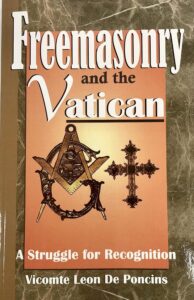
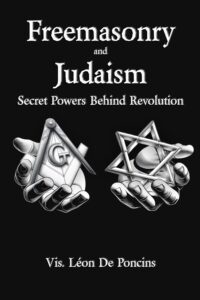
Vicomte Léon de Poncins descended from an old and distinguished French family with a long tradition of studying political and spiritual subversion.
He is renowned for his rigorous investigative method, which relied heavily on the writings and statements of his opponents to support his arguments.
His trilogy on Freemasonry, Judaism, and the Vatican remains one of the most thorough investigations of secret societies ever produced.
De Poncins guides the reader toward a deeper understanding of the roles of Freemasonry and Judaism, and their connections with socialism and communism. Beginning with the French Revolution, his works analyze the Masonic influences behind the revolutions in both France and Russia.
The Gnostic nature of the Masonic tradition is revealed through the writings of its Grand Masters, leaving little doubt about the occult and satanic aspects of their system.
Through these books, you will also gain access to an extensive collection of works and Christian papal documents from that period, providing valuable material for further study.
THE TRILOGY (links to the books)
TOPICS AND SMALL PARTS OF THE BOOK:
Naturalism and Satanism:
Note that these texts are not recent; they date from the 1920s, yet they describe precisely the paradoxes that modern New Age movements promote. To denigrate God and exalt the rebellious serpent has long been a typical narrative of the Gnostics. Freemasonry is pantheistic and secretive, promoting a path to salvation through works, closely linked to the mystery religions underlying Gnosticism. The “We are all gods” ideology, biased and distorted, may be as old as Cain.
“Now the Great Architect, no doubt because he is less trans-cendant than the God of the theologians, refers to an entity which does undeniably exist, for the constructive work of Freemasonry has, as its origin and inspiration, an ideal which gives birth to an immense energy. A force superior to themselves impels Masons and co-ordinates their efforts with an intelligence far exceeding that possessed by any one individual among them. Such is the hard fact which emerges and before which we bow our heads. Let every man interpret it as he pleases….” (O. Wirth: ibid., p. 58)
“In the book of Genesis, these ideas are expressed by the myth of the Earthly Paradise, a place of happiness in which primitive man had only to live, as do animals, or children who have not yet come to the age of reason. “The beguiling serpent, who incites us to eat the fruit from the tree of knowledge of good and evil, symbolises one particular instinct. He breaks away from the conservative instinct and represents both a nobler and a subtler impulse, whose purpose is to make man aware of his need to rise in the scale of beings. 88 FREEMASONRY AND THE VATICAN “This secret spur is the promoter of all progress, and of all the conquests which enlarge the sphere of action both of individuals and of groups. “That explains why the Serpent, inspiring disobedience, insubordination and revolt, was held accursed by the ancient theocracies, while at the same time he was honoured among the initiated, who considered that there could be nothing more sacred than those aspirations which lead us ever closer to the Gods, who are seen as rational powers, charged with bringing order out of chaos and with governing the world. “The object of the ancient mysteries was to make men like unto gods. The mystery took on more of the divine nature as it rose morally and intellectually further and further beyond the level of common humanity. The programme of Initiation has not changed even in our own day; the modern Mason, too, also becomes more divine, but he realises that he can only become so if he works divinely, that is, by completing the unfulfilled task of creation. Raised above the level of man’s animal nature, the Builder, by carrying out the divine plan, himself becomes a god, in the ancient sense of the word.” (O. Wirth: Le Livre du Compagnon, p. 74)
Freemasonry and Gnosticism:
“To those who may be surprised by the use of such an expression, we would say that there is a Masonic theology in the sense that there exists in Freemasonry a secret, philosophic and religious doctrine, which was introduced by the Gnostic Rosicrucians at the time of their union with the Tree Masons in 1717. This secret doctrine, or gnosis, belongs exclusively to the High, or philosophic, degrees of Freemasonry.” (Rabbi E. Benamozegh: Israel et l’Humanite, p. 73)
“‘Masonry’, says Albert Pike, in Morals and Dogma, ‘is the descendant of that higher science held by the ancient teachers of those ancient religions that once illuminated the minds of men.’ “Considering the fact, that these ancient faiths taught a secret as well as an open doctrine, as did Christianity in its early day; we come to the mysteries handed down from generation to generation, in secret traditions; given to those ready to receive and to properly impart them. “This science was known as the Gnosis. “The Gnostics derived their leading doctrines and ideas from Plato and Philo; the Zendavesta of the Persians; the Kabbalah of the Hebrews; and the sacred books of Egypt and India; and thus introduced in the early days of Christianity, that which formed a large part of the ancient teachings of the Orient.” (T. Stewart: Masonry and its Message, pp. 55-56)