
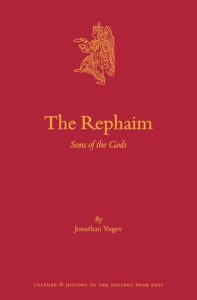
I recently came across this fascinating—though rather expensive—book by Jonathan Yogev, a scholarly study on the mysterious Rephaim. It’s an impressive work in which the author presents a detailed analysis of the Ugaritic texts discovered on tablets in the early 1900s.
From a Christian perspective, we can recall St. Paul’s words in 1 Corinthians 10:20–22, where he states that “the gods of the nations are demons.” Keeping this in mind, and with some prior knowledge of the Nephilim, readers will get much more out of Yogev’s research.
In line with Paul’s teachings, this book highlights the connections between the Rephaim, the demons of the underworld (who were said to have healing powers, as even occult traditions report), and ancient royal bloodlines. Other works—such as Gary Wayne’s excellent The Genesis 6 Conspiracy—are also helpful for exploring a related and undeniable fact: throughout history, myths and legends about these beings have persisted, and royal families have often claimed some form of “divine” ancestry. Of course, what they called divine was, in truth, far from holy; when you encounter the names of the deities they worshipped, you’ll see that there was nothing graceful about those cults.
Since Yogev’s book is written from a neutral academic standpoint, I wanted to clarify that while it’s a valuable and insightful read, Christians should approach it with discernment. It’s important not to be captivated by these myths, as they are tied to the principalities, kingdoms, and forms of idolatry that God consistently warns us about throughout Scripture.
For readers who wish to explore the topic in more depth, I will provide a summary of the chapters and a link to purchase the book.
Click on the Book to purchase:
Overview
Jonathan Yogev’s The Rephaim: Sons of the Gods (2021) is a philological and comparative study of the term Rephaim across Ugaritic, Phoenician, and Hebrew texts. Yogev aims to reconstruct who or what the Rephaim originally were, how their role changed over time, and what theological or ideological forces shaped those changes.
The book is divided into five chapters:
-
Introduction – outlines the purpose, methods, and research history.
-
Ugaritic evidence – studies the Rephaim (rpʾum) in Ugaritic texts.
-
Phoenician evidence – examines inscriptions where Rephaim appear.
-
Biblical evidence – analyzes how the Hebrew Bible treats the Rephaim.
-
Conclusions – synthesizes the data and proposes a historical-developmental theory.
Main Assumptions and Arguments
1. Terminology and Cross-Cultural Context
-
The word Rephaim (Hebrew rĕfāʾîm) corresponds to rpʾum / rp’um in Ugaritic and rp’m in Phoenician.
-
Yogev argues that the term cannot be understood solely from the Bible; it must be interpreted alongside these Northwest Semitic parallels.
-
The meaning and role of the Rephaim evolve across cultures: from honoured divine or heroic figures in Ugarit to negative or shadowy beings in the Hebrew Bible.
2. The Rephaim in Ugaritic Texts
-
The Ugaritic Rephaim are described as noble, semi-divine figures — sometimes called sons of the gods.
-
They appear in poetic and ritual contexts such as the “Poem of the Rephaim” (KTU 1.20-1.22), where they ride chariots, attend banquets, and interact with gods and kings.
-
These figures are linked with royalty, heroism, and divine ancestry. They are not mere spirits or ghosts but heroic ancestors or divine-human hybrids.
-
Yogev interprets them as mortal kings or heroes of divine lineage, venerated after death but still regarded as members of the divine realm.
-
Ugaritic rituals may have celebrated them in royal or cultic feasts, reinforcing the idea of sacred kingship and continuity between gods, heroes, and rulers.
3. The Rephaim in Phoenician Inscriptions
-
In Phoenician sources (e.g., the sarcophagus inscriptions of Tabnit and Eshmunazar), “Rephaim” designates honoured dead kings or ancestral spirits.
-
The inscriptions often invoke the Rephaim in connection with tomb curses or blessings, suggesting a belief in their continuing existence and power in the afterlife.
-
This shows a development from the Ugaritic concept: the Rephaim are still powerful and revered but now firmly located in the realm of the dead.
-
Yogev concludes that by the Phoenician period, the term Rephaim referred to the royal dead or deified ancestors, occupying a divine afterlife domain.
4. The Rephaim in the Hebrew Bible
-
In the Hebrew Bible, “Rephaim” appears in two main contexts:
-
As ancient giants or warrior peoples inhabiting Canaan or Transjordan (e.g., Deut 2–3; Gen 14; Josh 12).
-
As shades or spirits of the dead in the underworld (e.g., Isa 14:9; Ps 88:10; Prov 9:18; Job 26:5).
-
-
Yogev argues that these two usages are not contradictory but reflect the biblical reinterpretation of older Canaanite ideas.
-
The Israelite writers, committed to monotheism, rejected and redefined the older divine-heroic traditions.
-
Thus, figures once honoured as sons of the gods became, in Israelite memory, giants to be destroyed or powerless shades in Sheol.
-
The Bible’s negative tone reflects a theological polemic: the Rephaim represent rival divine beings, incompatible with Yahweh’s exclusive sovereignty.
5. Yogev’s Central Theory
-
The subtitle “Sons of the Gods” captures Yogev’s core thesis:
The Rephaim were originally regarded as divine or semi-divine beings — heroes, kings, or ancestors descended from the gods.
-
Over time, their portrayal changed:
-
Ugaritic stage – divine or semi-divine royal heroes (sons of the gods).
-
Phoenician stage – deified ancestors or royal dead in the afterlife.
-
Biblical stage – demythologized figures, reduced to giants or powerless dead.
-
-
This shift reflects the gradual suppression of polytheistic traditions in Israel and the reinterpretation of mythic figures into morally or theologically acceptable categories.
6. Key Thematic Features
-
Royal and divine ancestry: The Rephaim are consistently tied to kingship and divine descent.
-
Feasting and chariots: Common symbols of heroism, divine favor, and continuity between life and afterlife.
-
Afterlife and cult: Inscriptions and rituals indicate veneration of the Rephaim as continuing spiritual forces.
-
Biblical polemic: The Rephaim became a symbol of what Israel rejected — other gods and heroic traditions.
-
Diachronic development: Yogev stresses that “Rephaim” never had a single fixed meaning; it evolved over centuries according to cultural and theological shifts.
7. Scholarly Limitations and Notes
-
The Ugaritic sources are fragmentary, so much reconstruction is speculative.
-
Some of Yogev’s conclusions (especially regarding divine parentage) rely on inference rather than explicit statements.
-
Nevertheless, the work’s strength lies in its philological precision and comparative scope, bringing together evidence from Ugaritic, Phoenician, and Biblical traditions to propose a coherent evolution of the Rephaim concept.
8. Significance of the Study
-
Yogev’s work reframes the Rephaim as a theological and cultural bridge between Canaanite and Israelite religion.
-
It challenges the simplistic view of the Rephaim as merely “giants” or “ghosts.”
-
By tracing their transformation, Yogev illuminates how ancient Israel reinterpreted divine and heroic traditions to align with monotheism.
-
The book contributes to understanding how myth, ancestor worship, and royal ideology interacted in the ancient Near East.


1 thought on “The Rephaim Sons of The Gods (Jonathan Yogev) – Book Review”
Очень классная заметка, совсем недавно исследовал этой теме;
)