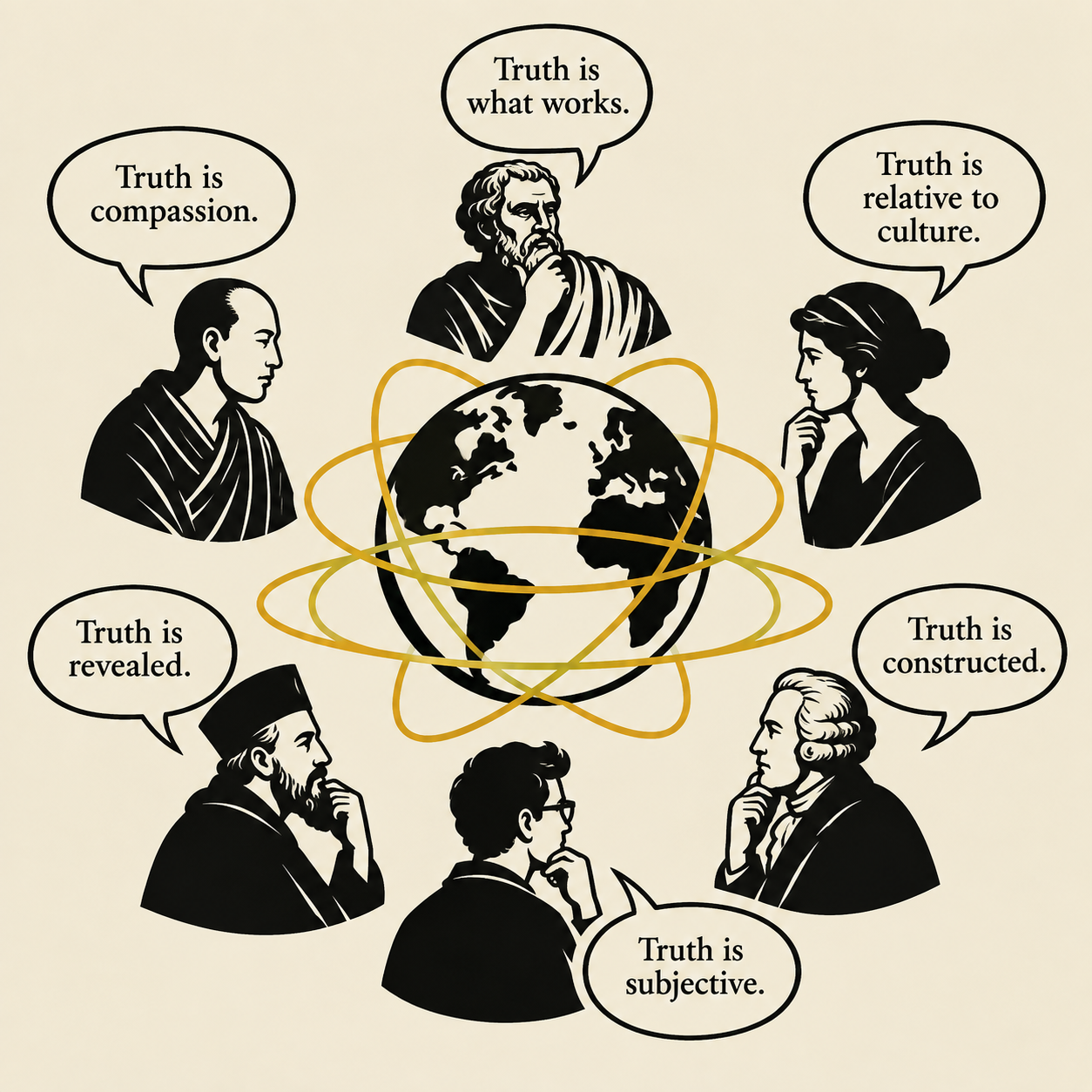
Relativism and Subjectivism as Ultimate Truth: A SelfDefeating Worldview
The Self-Refuting Nature of Relativism and Subjectivism
One of the most common positions expressed in discussions about
religion is that it does not matter what a person believes, provided
those beliefs are not imposed on others. According to this view,
everyone is entitled to their own religion, their own conception of
God, or even to no religion at all. Conflict arises only when
someone attempts to convince or compel others to adopt the same
beliefs. At first glance, this appears to be a tolerant and peaceful
position. Upon closer examination, however, it rests on
philosophical assumptions that undermine themselves.
The argument usually begins by claiming that no one can truly
know which religion is correct. Since no one has experienced life
after death, heaven, hell, or ultimate salvation, every religious
belief is said to be nothing more than a personal perception or a
tradition inherited from one’s parents or culture. From this
premise, the conclusion is drawn that no one has the right to
impose his or her beliefs on anyone else.
The difficulty is that this conclusion immediately raises an
epistemological question. If every religious claim is merely a
personal perspective, then on what basis can the claim that “no
one should impose their beliefs on others” be regarded as
universally true? Is that statement itself merely another personal
perception, or is it being presented as an objective truth that
everyone ought to accept?
This exposes a fundamental tension within relativism. The
relativist maintains that all truth is relative to individual
perspectives while simultaneously asking everyone else to accept
that proposition as universally binding. In other words, the claim
that “all truth is relative” is itself presented as an absolute truth.
The position therefore defeats itself. If the principle of relativism
is objectively true, then not all truth is relative. If, on the other
hand, relativism is itself merely one personal opinion among
many, then no one has any obligation to accept it.
A similar contradiction appears in the assertion that “nobody
knows anything.” Such a statement is itself a knowledge claim. To
affirm that no one possesses knowledge requires claiming to know
at least one thing: namely, that nobody knows. The argument
therefore collapses under its own weight. It attempts to deny the
possibility of objective knowledge while simultaneously relying
upon objective knowledge to make its case.
The appeal to peace also suffers from a similar problem. Peace is
often presented as a self-evident moral ideal that everyone ought
to pursue. Yet if no objective moral or epistemological foundation
has first been established, why should peace be preferred over
conflict? If morality is entirely subjective, another individual
could consistently maintain that domination, conquest, or violence
is preferable to peace. One person could even claim that his
religion commands him to wage war against those who disagree
with him. Within a purely relativistic framework, there is no
objective standard by which such beliefs could be condemned as
genuinely wrong rather than merely unpopular.
Appealing to the opinion of the majority does not resolve this
difficulty. Even if most people happen to value peace, the
popularity of an idea says nothing about its truth. Consensus does
not create objective morality. To argue that peace is good simply
because most people approve of it commits an appeal to the
majority, confusing widespread agreement with objective
justification.
The deeper problem is that concepts such as peace, tolerance, and
freedom cannot simply be assumed. They require a philosophical
foundation capable of explaining why they are objectively good
and why every individual ought to respect them. Without such a
foundation, these values become arbitrary preferences rather than
universal moral obligations.
Ultimately, the attempt to establish relativism or subjectivism as
the final truth is self-defeating. It simultaneously denies the
existence of universal truth while asserting universal claims about
truth, morality, and human behaviour. In doing so, it abandons the
very principles it seeks to defend. Rather than eliminating dogma,
relativism merely replaces traditional doctrines with one of its
own: the dogma that no one may claim objective truth—except,
paradoxically, the relativist himself.