INTRODUCTION
This century has been intellectually marked, in the West, by the growing influence of Eastern religions and belief systems such as Hinduism and Buddhism, often presented through a vocabulary of spiritual illumination, enlightenment, and supposedly new forms of wisdom. From the perspective developed in this essay, this constitutes another manifestation of an old Gnostic tendency: the promise of access to a hidden or superior form of knowledge through which human beings may attain a higher state of consciousness.
The Western popularisation of these doctrines was influenced by two particularly significant and, in my view, deeply problematic currents of thought. The first emerged in the nineteenth century through the development of Western occultism and esotericism, including circles such as the Hermetic Order of the Golden Dawn and, most notably, the writings of Helena Blavatsky.
She was one of the first foreigners to be given permission to enter Tibet. She wrote a nefarious periodical magazine named Lucifer. She created a branch of Gnostic heretical teachings called Theosophy. She inspired the Nazi regime with her Aryan racial theories, as she was one of the biggest promoters of these racial abominations and idiotic fantasies of forgotten lands, such as Atlantis and Hyperborea, while also fantasising about the coming of a new Messiah, whom she called Maitreya, mingling, in fact, with the Jewish rabbinical heresy of their Antichrist Messiah.
To spread these errors, the cabal used the second wave in the middle of the twentieth century and delivered these ideas through movies and music, fuelling the counter-revolution of the 1960s. The hippie movement, the Beatles, and rock and roll were simply tools to distribute the doctrines that had originated in the occult circles of the preceding century and to serve them on a plate to unprepared, ignorant, and disoriented drug addicts, who welcomed these new doctrines with much enthusiasm.
I’m ashamed to admit that, although I was never a hippie, I was and still am a fan of good music. I like to play and write, and the Beatles were a great musical inspiration for me. The cover of Sgt. Pepper’s, an album that I really enjoyed, will serve as the proof of what I wrote above. You will find most of the key figures of the New Age, and one who caught my attention in my 20s was the one up on the left, the nefarious Aleister Crowley.
Situations like this were the gateway for curious kids like me to enter into a series of unforgivable intellectual mistakes. I was very lucky that I kept my skepticism until the end. But I indeed read them all, so I can call myself both an expert and an adversary of everything that comes from the dirty satanic hole that has been popularised by the media as the New Age.
Now that I have used the word “satanic,” you may wonder what I mean by that. In theory, we are talking about Eastern religions, so theoretically, Satan has nothing to do with them. I will write another essay on why every pagan/polytheistic system is actually a counterfeit of truth and how these traditions attempt to mimic the eternal (uncreated) Triune God with a false primordial being that “emanates” three created “divinities” that are all separate and not in unity.
This is an extremely complicated concept that I will analyse in the next essays, and I will try to make it as intelligible and easy to understand as possible for everyone.
This short essay aims to explore the logical and intellectual fallacies of Eastern polytheism, rather than providing a complete theological debunking of the sinister counterfeit underlying every pagan religion. I would like to take a couple of lines to remark that I am truly sorry if, on a personal level, you are offended by what I am writing and by what I am about to share. However, this blog is about philosophy, and therefore you must understand that criticism and debate are among the most basic and important tools of human intellectual discourse. We cannot allow ourselves to become overly emotional about certain topics or condone errors that can lead to a fraudulent interpretation of reality.
The Intellectual and Moral Fallacies of Eastern Religions:
An Introduction to the Absurdities of Their Epistemology and Metaphysics. How Other Heresies Seem to Possess at Least a Small Measure of Logic, Something That Hinduism and Buddhism Surely Do Not.
Hinduism and Buddhism are often grouped together with religions such as Islam or Mormonism when discussing the truth claims of world religions. However, they differ in a significant respect. Islam and Mormonism present historical claims, identifiable figures, events, and assertions that can be investigated.
By contrast, Hinduism and Buddhism provide far fewer historical claims that are open to critical examination. In one sense, this makes them more difficult to evaluate historically, but in another, it makes them easier to dismiss.
There is no clear historical core, no public miracle, and no central falsifiable claim upon which either system ultimately depends. Once the cultural traditions and spiritual language are set aside, what remains are philosophical systems that, it may be argued, struggle to maintain logical coherence, let alone historical credibility.
A short introduction to this ridiculous deception that is poisoning our youth, together with a summary of some of its intellectual fallacies. These ideas began to invade the Western world at the end of the eighteenth century, when Eastern occultism started to spread beyond esoteric circles. This disgraceful movement was initially popularized by the nefarious figure of Helena Blavatsky, often regarded as the mother of Theosophy, and was further propagated by other controversial individuals such as Aleister Crowley. Most people who practice yoga know nothing about these historical connections.
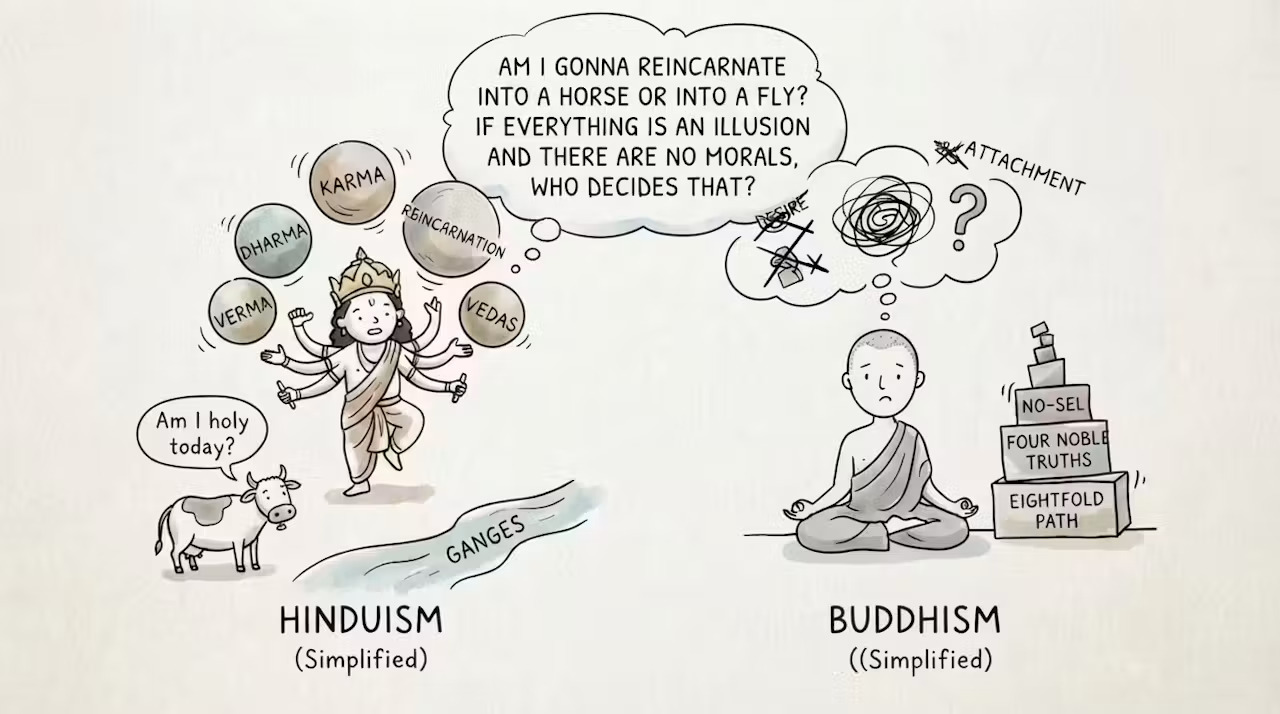
Hinduism illustrates this difficulty. In many of its forms, everything is ultimately one. Brahman is regarded as the only true reality, while distinctions between individuals, actions, and even moral good and evil are considered illusory.
Yet this raises immediate philosophical questions. If all reality is one, who is actually being deceived? If distinctions themselves are merely illusions, then the distinction between truth and falsehood must also be illusory, thereby undermining the truth claims of the system itself. The doctrine of karma likewise presupposes genuine moral agents making meaningful choices.
But if every individual is ultimately Brahman, who bears moral responsibility? Who is judged? Reincarnation also appears to require personal identity. If there is no enduring individual self and no memory linking one existence to another, then reincarnation becomes little more than endless repetition without genuine moral continuity or justice.
Buddhism does not appear to resolve these problems. Instead, it denies the existence of a permanent self altogether. Human beings are described not as enduring persons but as temporary collections of thoughts, sensations, and experiences. Yet if no enduring self exists, who is it that suffers? Who follows the Noble Eightfold Path? Who ultimately attains enlightenment?
The system seems to presuppose the very reality that it rejects. Furthermore, Buddhism teaches that desire is the root of suffering and that liberation is achieved through the elimination of desire. However, the pursuit of liberation itself necessarily involves the desire to attain it, making the system appear internally self-defeating.
Even before questions of historical evidence are considered, these philosophical tensions may be seen as significantly lowering the prior plausibility of both systems. Nevertheless, assuming for the sake of argument that these concepts possess a coherence beyond ordinary human understanding, the next question concerns the evidence supporting them. Hinduism contains numerous miracle stories, but these are generally not connected to identifiable eyewitness testimony.
Krishna, one of the most revered avatars of Vishnu, is said to have lifted a mountain with a single finger, multiplied himself to dance simultaneously with hundreds of maidens, and performed many other extraordinary acts. Yet these accounts appear at least a thousand years after the events they purport to describe and are not based on eyewitness reports.
More recent miracle workers, such as Satya Sai Baba, were accused of using sleight of hand to produce supposed miracles, including materialising watches and rings. He was also accused of sexual abuse and amassed considerable wealth through his reputation as a miracle worker.
The historical situation in Buddhism is not substantially different. The Buddha himself may well have been a historical figure, but the miracle stories associated with him, such as controlling the weather or taming wild elephants, appear centuries after his lifetime. The earliest surviving biographies of the Buddha date from roughly three to five centuries after his death.
There is no continuous chain of testimony and no publicly observable miracle claims that can be critically investigated. It is also noteworthy that many defenders of these traditions do not regard logical consistency or historical grounding as essential.
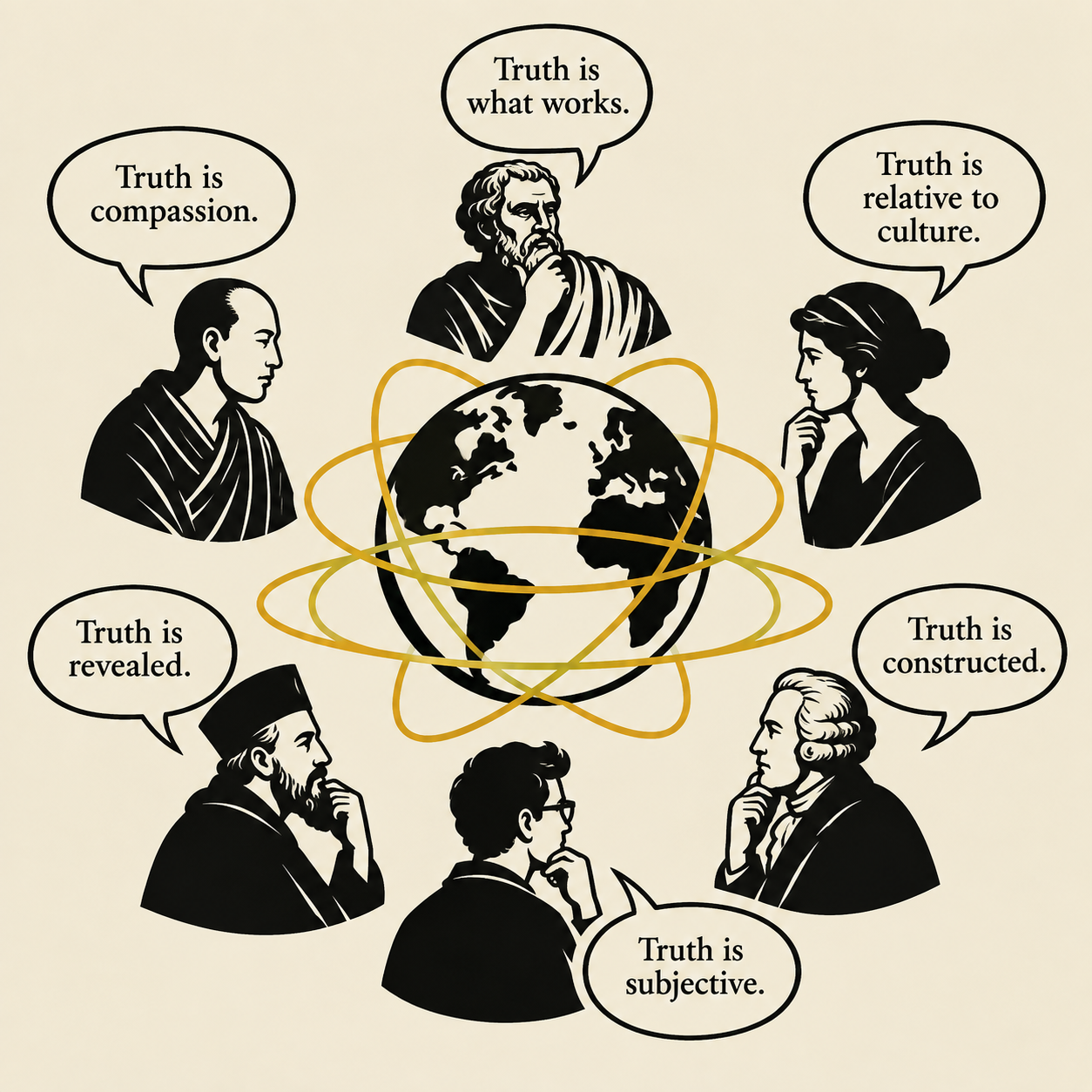
Questions concerning contradictions or the absence of evidence are often dismissed as products of a specifically Western approach to truth, implying that coherence and objective truth are merely cultural preferences rather than universal standards.
Yet if a worldview cannot, even in principle, be shown to be true either logically or historically, the question naturally arises as to why it should be regarded as credible.
Christianity, by contrast, grounds its central claims in public history. At the heart of the Christian faith stands the resurrection of Jesus, a claim that is presented as a historical event recorded in multiple early sources.
The Gospels provide names, places, and accounts of physical resurrection appearances witnessed by groups of people. The apostles themselves were willing to endure suffering for what they claimed to have personally witnessed, not merely for an abstract philosophical system but for events they maintained had actually occurred.
For these reasons, Hinduism and Buddhism are often regarded as requiring less attention as historical alternatives to Christianity. From this perspective, both systems appear to face significant internal philosophical difficulties while also lacking a verifiable historical foundation capable of supporting their central religious claims.