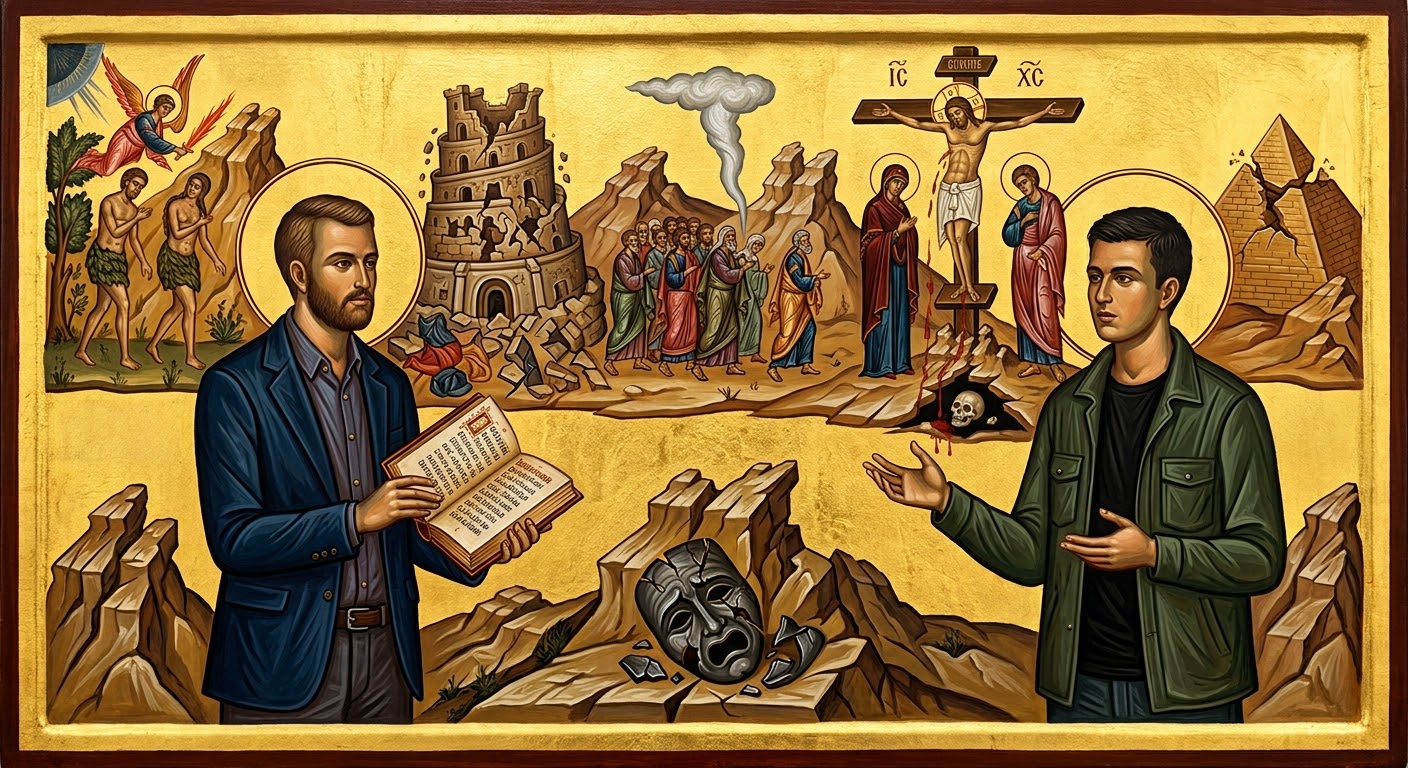
DIALOGUE ON ATHEISM AND TRUTH
Or: The Mask of Lucifer in the Modern World
In the Manner of the Church Fathers
Composed for the Edification of the Faithful and the Refutation of the Errors of Our Time
An essay by Ivan Vladimirov
PROLOGUE
To you, brothers and sisters in Christ, who toil in this time of great confusion, where falsehood cloaks itself in light and truth is crucified every day in the public square, I offer this dialogue. It is neither a rhetorical exercise nor an academic treatise. It is a mirror.
In it you will find Theophilus, whose name means “friend of God,” and Atheodorus, “without god.” Theophilus is not an angel, but a man instructed in the Sacred Scriptures and in the philosophy of the Fathers. Atheodorus is not a monster, but an educated man, sincere in his search, a prisoner of that deception which Saint Irenaeus of Lyons called “the gnosis falsely so called.”
Read carefully. For Atheodorus is yourselves before conversion, or he is your children, your friends, your colleagues. And Theophilus is the voice of the perennial Church, the one that has confessed the faith beneath the fangs of lions and beneath the guillotine, under the sun of Africa and beneath the ice of Siberia, and that today speaks to you through these pages.
May the Holy Spirit, who inspired the Prophets and the Fathers, enlighten those who read.
CHAPTER I
The Atheist and His Definition
THEOPHILUS: Greetings, Atheodorus. I have often seen you in public places, intent on reading and discussing. I am told that you define yourself as an atheist. May I ask you, with respect, what exactly you mean by this term?
ATHEODORUS: Greetings to you, Theophilus. Yes, I define myself as an atheist. I mean that I do not believe in the existence of God, or rather, of any god. I hold that human reason, guided by science and the observation of the world, is sufficient to explain reality without the need for supernatural hypotheses. I am a free man, finally emancipated from the fables of my fathers.
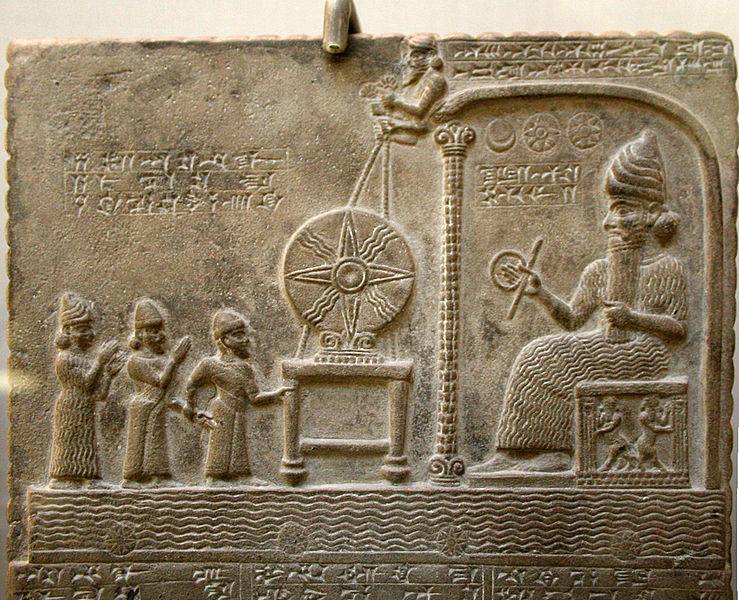
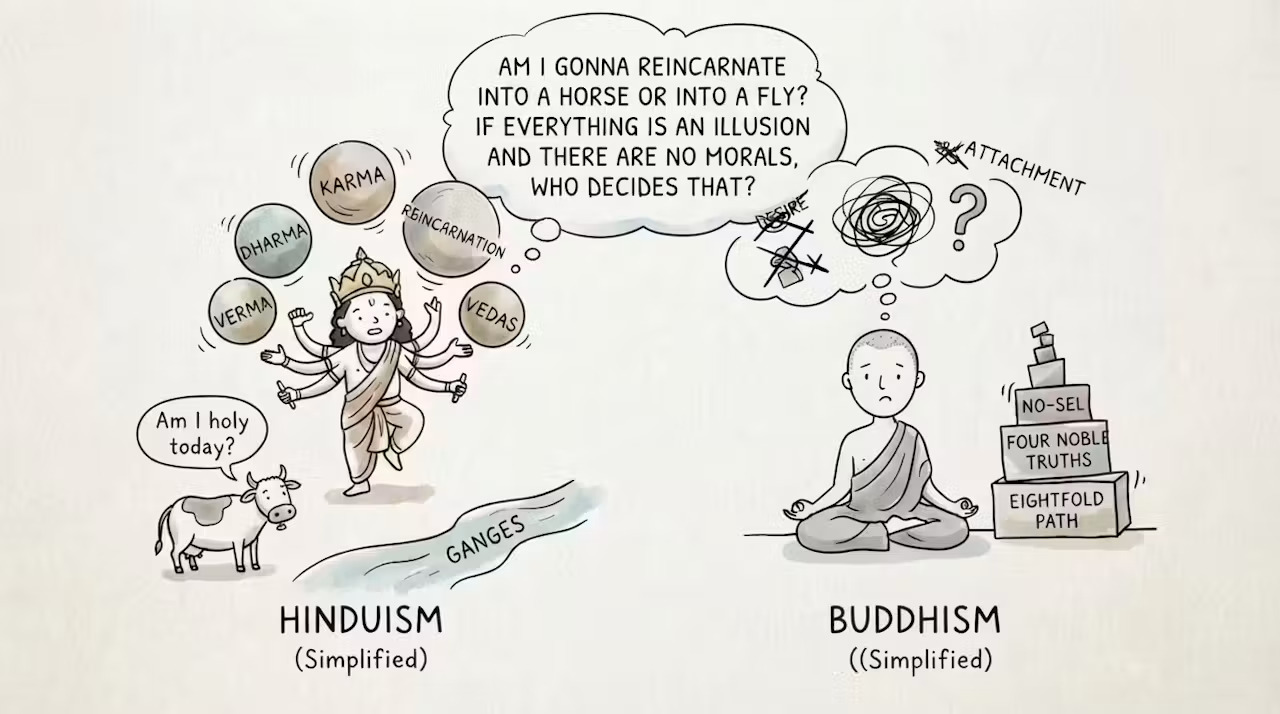
THEOPHILUS: I understand. But allow me a preliminary question: when you say “I do not believe in any god,” do you mean that you reject all the deities that humanity has imagined throughout history? Zeus, Odin, Ra, Vishnu, Quetzalcoatl… do you reject them all?
ATHEODORUS: Certainly. I reject them all. They are human inventions, products of the fear and ignorance of our ancestors. Myths created to explain what was not understood.
THEOPHILUS: Then on this point we agree. I, too, reject all those deities. The difference is that I reject ninety-nine of them, whereas you, from what you say, reject one hundred.
ATHEODORUS: Nice joke, Theophilus. I have heard it too. But the substance of the matter is that I am more consistent than you: I reject them all, while you accept one.
THEOPHILUS: And here, Atheodorus, allow me to disagree, respectfully but firmly. You believe that you reject all deities, but in reality you reject none, because the pagan deities, insofar as they are supreme ontological beings, do not exist. You and I agree on this. The difference is that I know that behind the rejection of God there is not nothing, but something else. And you, in rejecting the Creator, do not slide into emptiness, but into something very specific.
ATHEODORUS: And what would that be, according to you? Are you insinuating that I worship something against my will?
THEOPHILUS: Not against your will, but without your reason’s knowledge. Man, Atheodorus, is homo religiosus by nature. As Lactantius teaches, the human soul is naturally Christian. The heart of man is a vessel that cannot remain empty. If it is emptied of the true God, spiritual horror vacui inevitably drives it to fill itself with substitutes. And these substitutes, as Revelation teaches, are never neutral.
CHAPTER II
The Problem of Evil and the Privatio Boni
ATHEODORUS: Before following this line of reasoning, allow me to ask you the question that I know lies in the heart of every sincere man. I know what you would say to me if we met in a public square. You would look at me with that half-smile and say: “If God is omnipotent, omniscient, and good, why does evil exist?” That is your objection, is it not?
THEOPHILUS: It is the objection par excellence, Atheodorus. The cry of humanity’s pain, but also, often, the intellectual pretext of those who wish to free themselves from the yoke of the Creator. Allow me to answer you with an image of stark, inescapable reality: imagine that God, at this very instant, decided to eliminate evil from the face of the earth. Truly, completely, entirely. Would you be certain that you would still be here tomorrow? The people you love, your children, your parents, would you be certain that they would still be alive?
ATHEODORUS: Well… no, probably not. We are all sinners, in one way or another.
THEOPHILUS: There you are. You yourself admit that evil is not only “out there,” but also “in here.” And now tell me: what is evil? Is it a creature of God? Is it a substance that God created?
ATHEODORUS: No, obviously not. God cannot create evil, otherwise He would not be good.
THEOPHILUS: Exactly. And here the Church Fathers, from Saint Augustine to Saint Thomas Aquinas, come to your aid. Evil is privatio boni: it is the absence of good. It is not a substance, it is not a created entity. It is the empty space that man creates when he turns away from God, from grace, from love, from charity. But nature abhors a vacuum. And that ontological space, left free by the rejection of God, is inexorably filled.
ATHEODORUS: Filled with what?
THEOPHILUS: With created but fallen entities. With spirits that have rejected God and now seek to drag humanity down with them. You will tell me: “But I do not worship any god. I am an atheist. I believe in nothing.”
ATHEODORUS: And that is true.
THEOPHILUS: There you are, Atheodorus; this is the first great deception. The man who rejects the true God does not slide into nothingness. Man is homo religiosus by nature. If he does not worship the Creator, he will inevitably worship creatures, or worse, demons. The ancient pagan gods have not died. They have merely changed their liturgies.
CHAPTER III
The Ancient Idols That Have Changed Their Liturgy
ATHEODORUS: Are you saying that I worship gods without knowing it? This seems like madness to me.
THEOPHILUS: I will show you how they manifest themselves today. Allow me to give you a list, to show you how the ancient demons manifest themselves today, no longer under the names of old, but with the same, identical hunger for destruction.
First: Moloch, the God of Fire and Child Sacrifice.
In antiquity, children were sacrificed to Moloch by making them pass through the fire in the Valley of Topheth, in order to guarantee prosperity and harvests. Today there is no physical fire, but there is the fire of ideology and convenience. Moloch is abortion, where millions of children are burned upon the altar of selfishness, career, or the “right” not to have responsibilities. Moloch is euthanasia, where the elderly and the weak are sacrificed because they are “useless” to the productive system. Moloch is the decline in birth rates induced by an economic system that devours the future of the younger generations to nourish the present of the elderly. The blood sacrifice is still there; it has merely become legal and medicalized.
Second: Baal, the Lord of the Storm and Fertility.
Baal was the Canaanite god who controlled rain and agriculture. To appease him and secure the harvest, orgiastic rites were practiced and the first fruits of the earth were offered. Today Baal is Materialism and Unbridled Consumerism. He is the idol of the economy, the “market” that demands human sacrifices, unemployment, poverty, and exploitation in order to guarantee growth and GDP. Baal is the destruction of creation not out of necessity, but because of the greed for profit that knows no limits. We have exchanged the Creator for creation, and now we are slaves to the matter we ought to govern.
Third: Astarte, Ishtar, Aphrodite, the Goddess of Unrestrained Eros.
In antiquity, the worship of these goddesses involved sacred prostitution, the confused merging of the sexes, and the idea that erotic pleasure was in itself a divine act, detached from procreation and the family. Today Astarte is the pornography industry, which has commodified the human body, reducing it to a mere object of visual consumption. She is the sexual revolution that has separated the conjugal act from its procreative and unitive purpose. She is gender ideology, which attempts to erase the ontological reality of masculinity and femininity, creating an anthropological chaos in which man, refusing to accept himself as a sexually differentiated creature, attempts to proclaim himself the creator of himself.
Fourth: Mammon, the God of Wealth.
Although of Semitic origin, Mammon was assimilated into the Greco-Roman world as Plutocrates. He demanded that man devote his life to accumulation, making other human beings mere instruments for his own enrichment. Today Mammon is the financialization of existence. It is the system in which the value of a human being is not determined by his dignity as a child of God, but by his bank account. It is corruption, the greed of the elites, the reduction of the person to “human capital” or a “resource.” As Christ said, one cannot serve God and Mammon; atheism has chosen Mammon, calling it “economic progress.”
Fifth: The Cult of the Emperor, the Deification of the State.
In ancient Rome, the Emperor’s Genius demanded an offering of incense. It did not matter whether one believed in another god in one’s heart; the public act of submission to the State as an absolute reality was enough. Today this is Totalitarianism, whether political or technocratic. It is the State’s claim to define what truth, justice, and even morality are. It is the “single thought” that excludes from the public square those who dissent, treating them as heretics. It is the demand that the State provide social salvation, taking the place of Providence.
Tell me, Atheodorus, how many times have you offered sacrifices to these gods with your time, your money, your choices?
ATHEODORUS: It is not the same thing. These are human vices, sociological phenomena, not deities.
THEOPHILUS: Saint Paul would answer you: “What the pagans sacrifice, they sacrifice to demons and not to God.” Demons are not so stupid as to demand that you burn incense before a wooden statue. It is enough for them that you offer the sacrifice of your life, your body, your soul.
CHAPTER IV
On Anarchy and True Freedom
ATHEODORUS: But then, Theophilus, if the State, the economy, and science become idols, should one not rebel against every form of power? Is anarchy not true freedom?
THEOPHILUS: Here is the final deception, my friend. Anarchy without God does not produce freedom: it produces the law of the strongest. Without a transcendent God who guarantees the inviolable dignity of every person, without a natural law that binds everyone, the absence of power becomes the triumph of violence. Dostoevsky understood this: “If God does not exist, everything is permitted.” And when everything is permitted, the weakest becomes the slave of the strongest.
ATHEODORUS: But then what do you propose? Submission to every form of power?
THEOPHILUS: No. I propose the only true anarchy: Christian anarchy. The refusal to bend one’s conscience to any human power that contradicts the law of God. The first Christians were accused of “atheism” and “subversion” precisely because they refused to worship the Emperor. Not because they did not believe in a higher principle, but because they recognized only one King: Jesus Christ.
ATHEODORUS: But how can this be reconciled with obedience to the authorities?
THEOPHILUS: Through the distinction that Saint Paul himself makes, and that the Apostles sealed with their blood before the Sanhedrin. When they were ordered to remain silent, Peter replied: “We must obey God rather than men” (Acts 5:29). And yet Paul himself, writing to the Romans, teaches: “Let every person be subject to the governing authorities; for there is no authority except from God, and those that exist have been established by God” (Romans 13:1).
Do you see, Atheodorus? The Christian obeys human authorities, uses economic goods, respects civil laws, but only so long as they do not contradict the law of God. And when they do contradict it, he responds with the words of the Apostles: “We must obey God rather than men.” This is the only anarchy that does not degenerate into tyranny, because it recognizes an Archē, a Principle, above all human power.
ATHEODORUS: So true freedom is not the absence of every law?
THEOPHILUS: Exactly. True freedom is the ability to choose the good, not the license to choose evil. As Saint Augustine taught, “Love and do what you will”: if you truly love, if your love is ordered according to truth, then what you will can only be good. Freedom without truth is slavery to the passions; freedom with truth is divine sonship. Anarchy without God is the door flung wide open to the tyranny of the strongest; obedience to God is the only foundation of man’s true dignity.
CHAPTER V
The New Prometheus: Neo-Gnosticism, Technocracy, and Transhumanism
ATHEODORUS: But this is only one piece of the story, Theophilus. The modern world is not only materialism. It is also science, technology, progress. Perhaps we are simply overcoming the limits of human nature, as we always have.
THEOPHILUS: And here we touch upon the subtlest point, the most dangerous, the most Luciferian of all. There is one final idolatry, the most refined, one that cloaks itself in white coats and algorithms: the New Prometheus, the Gnostic Demiurge, Technocracy.
ATHEODORUS: Explain yourself more clearly.
THEOPHILUS: Saint Paul, writing to the Colossians, had already warned us about this deviation. He had cautioned us against “philosophy and empty deceit, according to human tradition, according to the elements of the world and not according to Christ.” Giuseppe Ricciotti, in his analysis of Paul, emphasizes how the apostle identifies with surgical precision the “philosophy” that is not according to Christ: it is not the legitimate use of reason, but a system of “empty deceit” that promises a superior knowledge detached from the historical and bodily reality of the Incarnation.
ATHEODORUS: But what are you talking about, concretely?
THEOPHILUS: About three faces of the same idolatry.
Neo-Gnosticism maintains that salvation does not come from grace, but from a “knowledge” reserved for a few initiates, the cultural, scientific, and political elites, while matter, the body, and tradition are seen as prisons to be overcome. It is the ancient heresy of Simon Magus, Valentinus, and Marcion, risen again in modern attire.
Technocracy, or Technia, from the Greek word for art elevated to an absolute principle, is the idolatrous faith in human technology. It is no longer the use of tools to serve man, but the subjection of man and society to the logic of technical efficiency, governed by a caste of experts who replace divine Providence with social engineering.
Transhumanism is the apotheosis of this rebellion. It promises immortality and the overcoming of biological limits—illness, aging, death—through artificial intelligence, genetic modification, and human-machine hybridization. It is the rejection of the condition of being a creature in order to assume the role of creator.
ATHEODORUS: And does this seem evil to you? Curing diseases, prolonging life, enhancing intelligence… is this not what man has always done?
THEOPHILUS: There is an abyssal difference between healing and replacing, between administering creation and rejecting one’s own nature as a creature. Transhumanism does not want to heal man; it wants to abolish him. It does not want to eliminate suffering; it wants to eliminate the human condition that makes compassion possible. It is the very same pride that caused Lucifer’s fall: the desire to be one’s own ultimate principle, freeing oneself from ontological dependence on the Creator.
ATHEODORUS: But is science not a gift from God?
THEOPHILUS: Science, yes. Scientism, no. Science is the ordered study of creation; scientism is blind faith in the material method, which denies everything that is not measurable: the soul, grace, transcendent truth. It is idolatry. And like all idols, it promises freedom and delivers slavery.
ATHEODORUS: Are you telling me that artificial intelligence is an idol?
THEOPHILUS: I am telling you that when man reduces himself to an algorithm, when he entrusts his moral decisions to a machine, when he dreams of “uploading” his consciousness to a server in order to obtain digital immortality, he is committing the same sin as Babel: he is building a tower that reaches heaven through his own efforts, bypassing the Creator. It is the Tower of Babel rebuilt with silicon and binary code.
CHAPTER VI
The Tower of Babel and the Origin of Global Idolatry
ATHEODORUS: Babel? What is this story? And how is it connected to everything you have told me?
THEOPHILUS: Sacred Scripture shows us the first collective manifestation of this pride in the story of the Tower of Babel. Men, united by a single language and a single purpose, said: “Come, let us build ourselves a city and a tower whose top reaches the heavens, and let us make a name for ourselves, lest we be scattered over the face of the whole earth.”
What were they seeking? They wanted to “make a name for themselves,” to take the place of God, to build, through their own efforts, a reality autonomous from the Creator. It was the first attempt at spiritual totalitarianism, the first “New World Order” founded on pride and the rejection of God.
ATHEODORUS: And what did God do? Did He punish them?
THEOPHILUS: No. God, in His mercy, understood that if humanity were to unite in atheism and pride, it would create a totalitarian machine capable of destroying itself and dragging all generations into damnation. For this reason, “He scattered them from there over the whole earth.” Not as punishment, but to prevent evil from triumphing definitively. The diversity of languages and cultures is a gift of divine mercy, a restraint upon human pride, a way of preventing humanity, united in error, from building its own hell.
Today, the forces at work in history are trying to rebuild Babel. They are trying to reunite humanity under a single ideological “language,” a single globalist orthodoxy, a single religion of atheist humanism that erases Christ and His Truth.
CHAPTER VII
The Expulsion from Eden and the Circle of Salvation
ATHEODORUS: Theophilus, all this fascinates me, but it raises another question. If God is so merciful, why, then, is the Old Testament full of stories of chastisements, expulsions, and punishments? This does not seem like the behavior of a God of love.
THEOPHILUS: Here we touch upon one of the most serious misunderstandings of our age, Atheodorus. You read Scripture through modern eyes, accustomed to seeing punishment as revenge. But God’s logic is infinitely deeper. Allow me to take you back to the beginning of everything, to the moment when humanity lost Paradise.
ATHEODORUS: The expulsion of Adam and Eve from Eden.
THEOPHILUS: Exactly. We often read that passage as a punishment, as the revenge of an offended God. But if you look carefully at the Scriptures, you discover a startling truth: God did not expel man from Paradise to punish him, but to save him.
ATHEODORUS: What do you mean by that?
THEOPHILUS: Listen to what the Lord says after the Fall: “Behold, the man has become like one of us in knowing good and evil. Now, lest he reach out his hand and take also from the tree of life, eat of it, and live forever!” And He adds: “The Lord God sent him out of the garden of Eden to work the ground from which he had been taken.”
Do you understand, Atheodorus? If Adam, now contaminated by sin, had eaten from the Tree of Life, he would have become immortal in sin. He would have been fixed for eternity in a state of separation from God, of rebellion, of spiritual death. He would have been an immortal demon, not a fallen son. The expulsion from Eden was not a condemnation, but an act of supreme mercy: God closed the way to the Tree of Life, placed the cherubim and the flaming sword, not to deny man life, but to prevent him from making his own ruin eternal.
ATHEODORUS: I had never thought of it in these terms.
THEOPHILUS: At that moment, God could have abandoned His creatures to the fate they had chosen for themselves. He could have turned His back on them. But He did not. Instead, precisely in that act of apparent severity, He began His great work: the Economy of Salvation. From that very first moment, He promised that “the offspring of the woman would crush the head of the serpent.” He did not abandon Adam, He did not abandon Eve, He did not abandon humanity. He began a patient plan, spanning millennia, to recover what had been lost.
This is why the scattering at Babel, like the expulsion from Eden, is not revenge. It is divine pedagogy. God permits pain, separation, and confusion so that, through them, man may understand that outside Him there is only nothingness. Every apparent punishment from God is, in reality, a bitter medicine administered by a Father who does not wish to lose any of His children.
CHAPTER VIII
From Babel to Quarantine: The Geopolitics of Salvation
ATHEODORUS: Theophilus, all this fascinates me, but it raises yet another question. If these “demons” or fallen powers corrupted the nations after Babel, why did God not intervene earlier? And why is the Old Testament so full of wars, of commands to exterminate peoples such as the Canaanites? This does not seem like the behavior of a God of love, but of a warlord who wants to conquer a territory.
THEOPHILUS: You have touched the exposed nerve of modern exegesis, Atheodorus. The objection appears solid, but it collapses as soon as one understands the logic of sacred history. To do so, we must return to Babel and read a crucial passage from Deuteronomy, in its Septuagint version, the Greek translation used by the Apostles.
Listen: “When the Most High gave an inheritance to the nations, when He separated the sons of Adam, He established the boundaries of the peoples according to the number of the angels of God. But the Lord’s portion was His people, Jacob, His allotted inheritance.”
ATHEODORUS: “According to the number of the angels of God”? What does that mean?
THEOPHILUS: It means that, after the dispersion at Babel, God entrusted the pagan nations to the governance of angelic powers. However, as the Church Fathers teach, from Justin Martyr to Clement of Alexandria, many of these angelic powers fell into pride. Instead of guiding the nations toward the Creator, they demanded to be worshipped as gods. Thus the pagan pantheons came into being: Zeus, Baal, Moloch. They were not inventions of the human imagination, but the mask of fallen spiritual creatures that demanded worship.
In the face of this global apostasy, God implemented an emergency plan, a rescue operation for humanity: He chose one man, Abraham, to build a single people.
ATHEODORUS: A chosen people. But is that not elitist? And why all those wars?
THEOPHILUS: It was not elitism, Atheodorus; it was a spiritual quarantine. Imagine a physician who, faced with a deadly pandemic that has infected the entire world, isolates a single group of people in a protected area, not as a privilege, but to preserve the only serum that will be able to save everyone else in the future.
The people of Israel were “stiff-necked,” immature, and often unfaithful. But they were the only vessel that contained knowledge of the true God and, above all, the promise of the Messiah. The wars of the Old Testament were not imperial conquests, but surgical acts of defence. God commanded that peoples such as the Canaanites be driven away, not to steal their homes, but because their practices—human sacrifice, sacred prostitution, total idolatry—were an ontological virus that would have destroyed Israel’s monotheistic faith before the Saviour could even be born.
ATHEODORUS: But one could object that other peoples of antiquity did equally horrible things, and yet they were not attacked in the same way. Why the Canaanites in particular? Was it not merely an excuse to justify the invasion of a specific territory?
THEOPHILUS: Here the ingenious geopolitics of Providence comes into play, as also masterfully illustrated by historical scholars such as Giuseppe Ricciotti. The Promised Land was not just any territory. It was the “Syro-Palestinian corridor,” the only land bridge connecting three continents: Africa, Asia, and Europe.
If God had chosen to preserve His people in an isolated valley in Central Asia or in the depths of Africa, the message of Salvation would have remained confined. Instead, by placing Israel at that crossroads of the ancient world, God was preparing the perfect stage. When the “fullness of time” arrived, that same land would be traversed by Roman roads and Greek would be spoken there, allowing the Gospels to spread throughout the Empire in a few decades. It was not a territorial conquest; it was the logistical preparation for the Incarnation.
ATHEODORUS: So the harsh measures of the Old Testament were a lesser evil intended to prevent an absolute evil: the loss of the Messiah.
THEOPHILUS: Exactly. It was temporary protection. But what happened when the time of quarantine ended? What happened when the Word became flesh and walked upon that very land?
ATHEODORUS: Not everyone recognized Him.
THEOPHILUS: Not only did they fail to recognize Him, Atheodorus. A significant part of that people, particularly its religious elites, actively rejected Him, persecuted Him, and crucified Him. And at that historical and spiritual moment, the definitive tragedy was fulfilled.
Those who, despite possessing the Law and the Prophets, rejected the incarnate Logos, spiritually allied themselves with those very fallen powers that their fathers had fought. Thus was born, in a theological and spiritual sense, what the Book of Revelation calls the “synagogue of Satan.”
CHAPTER IX
The Synagogue of Satan and the Luciferian Design
ATHEODORUS: This term seems serious to me. And dangerous. Has it not been used to justify persecutions?
THEOPHILUS: Be careful: Orthodox theology teaches us that this is not an ethnicity, but a spiritual condition. The “synagogue of Satan” is the assembly of those who, while claiming to believe in God, deny Him through their deeds. It includes nominal Christians who empty the Gospel of its substance in order to adapt it to the spirit of the world. It includes those who, despite having received the Law and the Prophets, reject the promised Messiah and persecute His followers, as Saul of Tarsus did before his conversion on the road to Damascus.
It is this spiritual “synagogue,” which cuts across outward religious appearances, that, through indifference, moral relativism, and the covert promotion of vice, works tirelessly to drive Christ out of the public square and from the consciences of men.
ATHEODORUS: But all this seems a little… conspiratorial to me. Do you not think you are exaggerating? You are describing a coordinated design, an occult committee that manipulates the world.
THEOPHILUS: No, Atheodorus. It is not a conspiracy; it is a spiritual reality. Saint Paul speaks of “principalities and powers,” of the mysterium iniquitatis. There exists a spirit at work in history, whose objective is not simply to make men doubt, but to erase Christ from history, obscure the Truth of the Gospel, and make man forget his own Redeemer.
And here we arrive at the heart of the Luciferian deception. This force does not ask you to worship evil explicitly. It asks you only to believe that you are free, autonomous, masters of your own destiny. It whispers to you: “You do not need God, you can be sufficient unto yourself, you can build paradise on earth with your reason and your technology.”
ATHEODORUS: And is that a bad thing? Is man’s autonomy not a value?
THEOPHILUS: It is the very same lie that the serpent whispered to Eve: “You will be like God.” It is the very same pride that caused Lucifer’s fall: the desire to be one’s own ultimate principle, rejecting ontological dependence on the Creator. Modern atheism is the secularization of this non serviam: the arrogance of believing that man, a finite and contingent creature, can make himself the absolute architect of good and evil.
ATHEODORUS: And who would these builders of the new Babel be?
THEOPHILUS: I am not looking for proper names, Atheodorus. I am looking for spiritual structures. The technocratic elites that promote gender ideology as a global dogma, the foundations that impose abortion as a universal human right, the media that systematically demonize the Church while celebrating every form of modern idolatry, the Masonic lodges that have worked for centuries toward the desacralization of society—all these, consciously or unconsciously, are instruments of this design. It is not a conspiracy; it is the internal logic of the mysterium iniquitatis.
CHAPTER X
Filial Freedom vs. the Slavery of Autonomy
ATHEODORUS: But then, Theophilus, why does God allow all this? If He is omnipotent, why does He not intervene? Why does He not destroy these builders of Babel?
THEOPHILUS: Because love cannot be coercive, Atheodorus. God respects your freedom to the very end, even when you use it to destroy yourself. But God never abandons you. Every suffering, every pain, every emptiness that sin creates in your heart is, in reality, an invitation, a call, a grace knocking at the door.
ATHEODORUS: But this seems to me like a weak God.
THEOPHILUS: He seems weak to you because you confuse patience with powerlessness. God, in His infinite patience and mercy, grants us time. He allows us to make mistakes, to fall, to experience firsthand the terrifying emptiness that sin creates. But He does so so that, through the experience of pain and nothingness, we may understand that He alone is Being. Evil exists because we reject God, and it generates suffering because man, deceiving himself, attempts to take His place.
The answer to the problem of evil is not the abolition of freedom, but the Cross of Christ. There, the incarnate Word took upon Himself the emptiness of our rejection, filling it with the infinity of His grace.
ATHEODORUS: But is Christianity not also a religion of rules? A list of prohibitions?
THEOPHILUS: Here you touch upon a fundamental misunderstanding, Atheodorus. Even before defining itself as a religion, Christianity is above all the effort and the witness of spreading the Truth in Christ throughout the world, everywhere, with respect and without imposition. Unlike all other religions, which are a list of rules to be followed, the God of Christians is not a God who imposes rules to be followed. He is a God who reveals the Truth, Love in Christ, and also allows us to make mistakes, to distance ourselves from Him, not to recognize Him, or even to offend Him.
He gives us time to undertake a journey, with the hope, mercy, and forgiveness of welcoming us when we realize the mistakes we have made, repent, and embrace Him. He does not force us to love Him; we would be slaves. He gives us freedom because we are children.
The rules of the Church are like the banks of a river: they do not serve to restrict the water, but to prevent it from dispersing into the marsh, allowing it to flow powerfully toward the sea.
CHAPTER XI
The Historicity of Christ and the Truth of the Gospel
ATHEODORUS: But how can you be so certain that Christianity is true? What if it were just another religion, another mythology?
THEOPHILUS: Here is the decisive question. And here I must ask you: have you ever truly read the Gospels? Have you ever studied the coherence of the theology of the Fathers? Or are you rejecting a caricature constructed by others?
ATHEODORUS: I have read some of them. But the historicity of Jesus is debated. Many maintain that He is a myth.
THEOPHILUS: This is the first lie you must unmask. The historicity of Jesus of Nazareth is a solid historical fact, attested not only by the Gospels, but also by non-Christian sources such as Tacitus, Suetonius, and Flavius Josephus. Giuseppe Ricciotti, in his monumental Life of Jesus Christ, demonstrates how the Gospels are not late legends, but documents rooted in the Palestinian context of the first century, rich in verifiable topographical, linguistic, and cultural details. There is no trace of that historical “void” typical of myths.
And then, Atheodorus, there is an incontrovertible psychological argument: the transformation of the Apostles. Eleven frightened men, who had hidden themselves after the crucifixion of their Master, suddenly become fearless, preach in public, and face martyrdom one after another. Human psychology cannot explain how eleven men could invent a lie knowing they would die for it. A lie requires earthly benefit; martyrdom is its total negation. Only the actual vision of the Risen One explains this ontological change.
ATHEODORUS: But have the Scriptures not been translated and retranslated? Have they not been altered?
THEOPHILUS: Translation is always a betrayal, skeptics say. But this is an objection that reveals more ignorance than acumen. The task of the Church throughout history has been to preserve and spread the Truth, despite the fact that language and the meanings of words change over time. This inevitably leads to changes in translations, but these are not changes intended to conceal or hide the truth; they are simply intended to make it understandable to ordinary people in the present day.
Let me give you a secular example: the word “economy.” A grandmother in the 1950s would have defined “economy” as household saving. Today, a young person in 2026 probably understands the word “economy” to mean investing in finance or making money. It is the same word, but its meaning has changed over three generations. Therefore, to make the concept of saving understandable to a young person in 2026, one can no longer use the word “economy” without notes and explanations.
In the same way, the Church, in accordance with the hermeneutics of continuity taught by Benedict XVI, adapts its linguistic formulation without ever altering the theological meaning. On the contrary, malicious alterations exist elsewhere: after the advent of Christianity, some Jewish translators modified the Septuagint precisely to de-Christianize it, changing, for example, “virgin” to “young woman” in Isaiah, in order to deny the prophecy of the Incarnation. This proves that Christians read Christ in the Scriptures from the very beginning, and that the reaction was to alter the text, not that Christians invented Him.
ATHEODORUS: But why is Christianity attacked so much? Why does it provoke so much hostility?
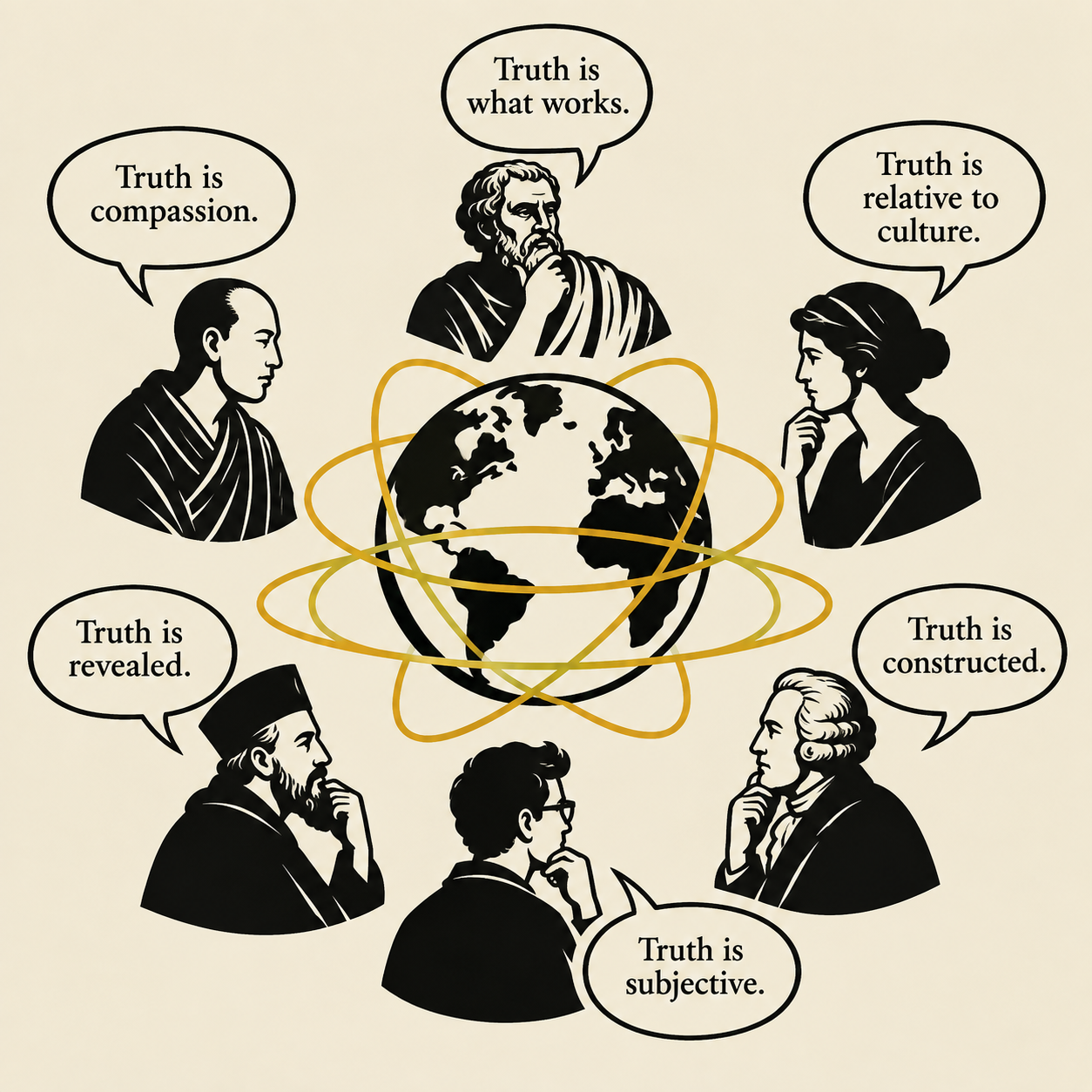
THEOPHILUS: Observe the world around you, Atheodorus. When Christ is discussed, reactions today are very hostile. Whereas one can speak calmly about all other religions without causing offense. Why? Because it is the Truth that causes offense in a world that seeks to turn falsehood into dogma.
There is only one Truth, and it is the one found in Jesus Christ. The rest are religions, idolatries, which cause no offense because they were created by Satan, or permitted by Him, and Satan does not promote them against himself. Those who are attacked today are those who proclaim Christ. And even if the official media do not speak much about it, Christians have always been, and still are today, fiercely persecuted. If you speak of Christ, you can be accused of being offensive, or homophobic, or anything else that has been instilled in people’s minds about Christianity, distorting the Scriptures.
A true atheist, intellectually honest, should first study what Christianity actually says, reading the Gospels and the Fathers, not anti-clerical caricatures. Because if he discovered that Christ truly is the Logos, the incarnate Reason who gave dignity to man in the face of every form of barbarism, he could no longer deny Him without doing violence to his own conscience.
Atheism is not the absence of faith; it is a deviation of faith toward the father of lies, of whom the Gospel of John speaks, who speaks “of his own”: “He came to His own, but His own did not receive Him.”
CHAPTER XII
The Circle Closes: From the First Tree to the Cross
ATHEODORUS: Theophilus, everything you have told me is coherent, but it leaves me with a terrible anguish. If God expelled Adam and Eve from Eden to preserve them, if He scattered Babel out of mercy, if He chose a people for quarantine… then it seems that humanity was left to its own devices for millennia. God preserved us, yes, but then did He abandon us to our fate? Did He allow evil to triumph throughout history, the demons to divide the nations among themselves, and man to suffer, fall ill, and die? Where is His concrete mercy, not merely theoretical mercy?
THEOPHILUS: Atheodorus, you have asked the decisive question. And it is here that the beauty of the divine design reveals itself in all its astonishing depth. God did not merely preserve humanity. From the very first moment of the Fall, God prepared the remedy. And this remedy was not given in just any place, nor at just any time. It was given precisely at the place of the Fall, to show that God’s mercy is greater than man’s sin.
ATHEODORUS: What are you talking about?
THEOPHILUS: I take you to Golgotha. The place of the skull. That is what the Gospels call it: Golgotha, which in Aramaic means “place of the skull.” The Tradition of the Church, founded upon an unbroken chain of witnesses reaching back to the Apostolic Fathers, from Origen to Saint Jerome, from Saint Epiphanius to Saint John Chrysostom, has handed down to us an astonishing truth: beneath the Cross of Christ, right there, at the highest point of Calvary, the skull of Adam was buried.
ATHEODORUS: Adam? Buried right there?
THEOPHILUS: Yes, Atheodorus. It is not a pious legend, but a tradition rooted in Scripture itself. Saint Paul, writing to the Romans, declares: “Where sin abounded, grace abounded all the more.” And sacred geography fulfills this word literally, dramatically, ontologically. The blood of Christ, flowing from the Cross, runs down the rock and reaches the bones of the first man. It is as if Christ, in dying, were bending over the abyss of human death and breathing once again, with His final breath, the breath of life upon that skull which had introduced death into the world.
ATHEODORUS: But why there, of all places? Why this symbolism?
THEOPHILUS: Because God is an artist, Atheodorus. And because He wants us to understand, with our eyes even before our minds, that His mercy is not an afterthought, not a Plan B. It is the eternal plan, prepared from the foundation of the world.
Do you remember what happened in Eden? Adam and Eve reached out their hands toward the tree of the knowledge of good and evil, ate its forbidden fruit, and death entered the world. God, in His mercy, drove them out of the garden “lest they stretch out their hand and take also from the tree of life, and eat, and live forever.” The tree of life was denied to them because eating from it as sinners would have meant making their ruin eternal.
But God had not abandoned His plan. He had merely postponed the gift until the time when man would be prepared to receive it without the danger of eternal damnation.
ATHEODORUS: And that moment is the Cross?
THEOPHILUS: Exactly. Now listen to the fulfillment of the entire plan. The Cross of Christ is the new Tree of Life. It is not a poetic symbol, Atheodorus; it is an ontological reality. Saint Paul says it clearly: “Christ redeemed us from the curse of the law by becoming a curse for us, as it is written: Cursed is everyone who hangs on a tree.” The wood of the curse becomes the wood of blessing. The tree that had brought death becomes the tree that brings life.
And the fruit? The fruit of this new tree is no longer forbidden. On the contrary, it is offered to everyone, freely, without conditions. And what is this fruit? It is not a plant-based fruit, Atheodorus. The fruit of the tree of the Cross is Christ Himself. It is His broken Body, it is His poured-out Blood, it is His divine Person giving Himself to humanity.
ATHEODORUS: Christ… the fruit of the tree of life.
THEOPHILUS: Yes. And notice the perfection of the plan. In the first garden, man ate a fruit in order to become like God, and lost everything. In the new garden, because Golgotha is called by the Fathers the “new Eden,” God Himself becomes the fruit and gives Himself to man, so that man may become a partaker of the divine nature, not through pride, but through grace.
In the first garden, man seized what did not belong to him and was cast out. In the new garden, God Himself allows Himself to be seized, nailed, and broken, so that man may be welcomed back.
ATHEODORUS: But then… Adam’s sin…
THEOPHILUS: It is what the Church sings on Easter night, Atheodorus, in the Exsultet, the oldest chant of the Christian liturgy: “O felix culpa, quae talem ac tantum meruit habere Redemptorem,” “O happy fault, that merited such and so great a Redeemer.” This is not an exaltation of evil, mind you. It is the astonished confession of God’s mercy. Adam’s sin was real, terrible, devastating. But God, in His loving omnipotence, permitted an even greater good to emerge from that evil: the Incarnation of the Word, His Passion, His Death, and His Resurrection.
ATHEODORUS: So the Cross…
THEOPHILUS: The Cross is the precise point at which the circle closes. There, beneath the wood of the Cross, lies Adam’s skull. There, upon the wood of the Cross, is the Body of Christ, the New Adam. There, the blood of the Second Adam flows over the skull of the First, washing it, purifying it, raising it from the dead. There, the curse of Eden is revoked. There, the Tree of Life, which had been denied to sinful man, is finally offered to redeemed humanity.
And notice, Atheodorus, the most extraordinary thing. Christ does not say: “Whoever eats of this fruit will live forever.” Christ says: “Whoever eats my flesh and drinks my blood has eternal life, and I will raise him up on the last day.” The Tree of Life is no longer forbidden. It is offered. And its fruit is the Eucharist, the Body and Blood of Christ, which the Church distributes to all those who approach in faith.
ATHEODORUS: Then… then God has never abandoned us.
THEOPHILUS: Never, Atheodorus. Never. From the very moment Adam and Eve hid among the trees of the garden, God was searching for them. From the very moment He drove them out of Eden, God was preparing their return. Every prophet, every sacrifice, every law, every exile, every hope of Israel—all of it was preparation for that moment. And when the moment arrived, when the fullness of time had come, God sent His Son, born of a woman, so that He might be born in the very place of the Fall, die in the very place of the curse, and rise again to open to all the Adams the gate of the paradise that had been closed.
ATHEODORUS: And I… where do I fit into all this?
THEOPHILUS: You are there, Atheodorus. You are one of those Adams whom Christ came to seek. His blood was shed for you, too. The Tree of Life has been planted for you, too. Its fruit is offered to you, too. But you must have the courage to stretch out your hand. Not to seize, as the first Adam did, but to receive, as a child receives a gift from the Father.
CHAPTER XIII
The Final Appeal and the Conversion of the Heart
ATHEODORUS: A long silence. But then… why does God allow all this? If He is omnipotent, why does He not intervene once and for all?
THEOPHILUS: Because love cannot be coercive, Atheodorus. God respects your freedom to the very end, even when you use it to destroy yourself. But God never abandons you. Every suffering, every pain, every emptiness that this spiritual “synagogue” creates in the human heart is, in reality, an invitation, an appeal, a grace knocking at the door.
The final question is not “Why does God allow evil?” but “Why, when faced with God’s infinite love, does man continue to choose nothingness?”
Christ died on the Cross for this. For you, unwitting atheist. For you, who believe yourself free but are a slave. For you, who worship modern idols and call them “progress.” Christ took your emptiness upon Himself, drank the cup of your deceit, and conquered death through His resurrection.
The door is open. The Truth awaits you. But you must have the courage to admit that you have been deceived. You must have the humility to recognize that you are not God, but a creature. You must have the strength to break the chains you yourself have forged, calling them “freedom,” and to leave the assembly of hypocrisy in order to return to the Father’s House.
ATHEODORUS: His voice grows quieter. I… I had never thought about it in these terms.
THEOPHILUS: After a long silence. Theophilus… I don’t know what to say. You have dismantled my certainties, one by one. I don’t know if I’m ready to believe. But I know that I can no longer go on living as though nothing had happened.
THEOPHILUS: I am not asking you to believe in one more god, Atheodorus. I am asking you to open your eyes to reality. I am asking you to stop worshipping your masters and to kneel before the One who created you out of love, who died for you, and who awaits you with open arms. The choice is yours. But know this: every choice against Christ is a choice for nothingness. And nothingness, in the end, has a name.
ATHEODORUS: What name?
THEOPHILUS: Eternal damnation. But there is another name, too. It is called Eternal Life. And that door is still open.
ATHEODORUS: He rises, visibly shaken. Theophilus, I need to reflect. Thank you for this dialogue. I promise nothing, but… I think I will come back and speak with you.
THEOPHILUS: The door is always open, Atheodorus. And so is the Heart of the One who awaits you.
EPILOGUE
The Essence of Apologetics and the Economy of Salvation
To you who practice the defense of the faith, and to you who read these lines still searching for the Truth, let this be the final seal of our discourse.
Apologetics, as Saint Peter teaches us, is not merely an intellectual exercise or a sterile struggle to have the last word: “Always be ready to give an answer to anyone who asks you for a reason for the hope that is in you. Yet do this with gentleness and respect.” Our ultimate purpose is not to win a debate, but to win a soul for Christ, snatching it from the darkness of deception and leading it back to the light of Grace.
If even one person, upon reading these words, feels their heart stirred, ceases to worship modern idols, and turns their gaze toward the Face of the One who is the Way, the Truth, and the Life, then every effort will have been repaid a thousandfold.
Is this perhaps the very essence of Christianity? Yes, without a doubt. Christianity is not a static religion, a code of rules, or one consoling refuge among many. It is the dynamic, living, and unceasing effort to spread the Truth in Christ, the Gospel, even at the cost of martyrdom, understood not merely as the shedding of blood, but as the supreme and total witness borne through one’s own life, so as to allow the Holy Spirit to accomplish His divine economy of salvation. We are the instruments, but God is the Craftsman.
For this reason, allow me to address a specific word to each of you:
To you who practice apologetics: do not fight out of intellectual pride, but out of pastoral charity. Your weapon is not the arrogance of reason, but Truth animated by Love. Remember that Saint Paul planted and Apollos watered, but it was God who made it grow. Your eloquence without the Spirit is a resounding gong; your humility with the Spirit is a transforming fire.
To you who already believe in Christ: do not reduce your faith to a religious practice or a cultural habit. Live as a witness. Know that the world does not need Christians who resemble the world, but saints who, like grain ground into flour, become pure bread for the lives of others.
To you who have not yet encountered Christ and define yourselves as atheists: know that these words are not an attack on your freedom, nor an attempt at indoctrination. They are a cry of fraternal love. We are not asking you to adhere to a human institution or to one “religion” among many. We are asking you only not to close the door on the One who knocks, on a Person who loves you more than you love yourself, and who faced the Cross precisely to snatch you from the nothingness that is being sold to you today as “freedom.”
We plant, we water, but it is God who makes things grow. We entrust every word spoken, every doubt raised, and every heart touched to the silent, powerful, and irresistible action of the Holy Spirit.
CONCLUDING PRAYER
From Psalm 118:42–46
“Then I shall have an answer for those who insult me,
for I have placed my trust in Your word.
Never take the word of truth from my mouth,
for I have placed my hope in Your judgments.
I shall walk in freedom,
for I have sought Your precepts.
I shall speak of Your teachings before kings,
and I shall not be ashamed.”